
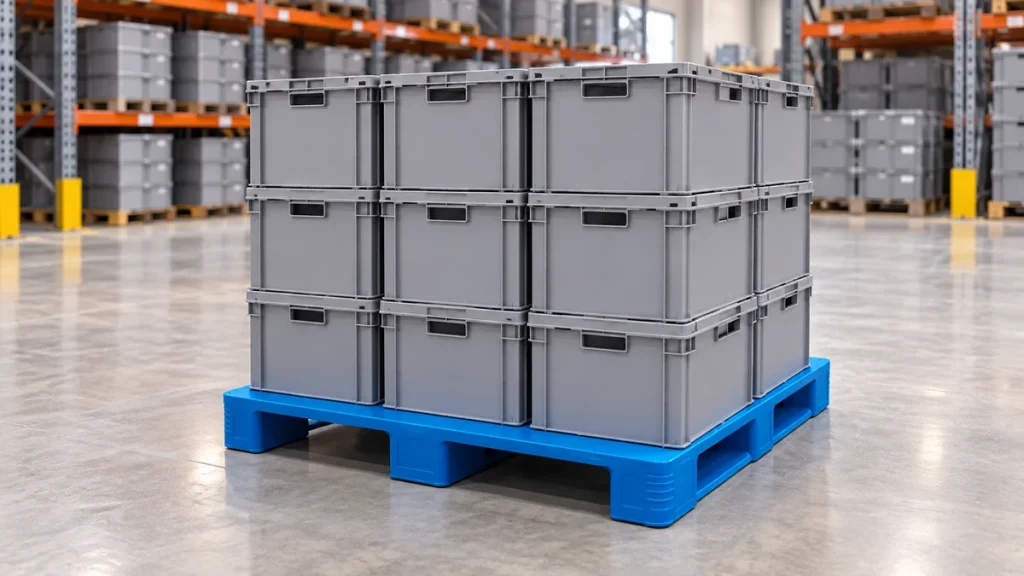
E-commerce fulfillment creates a pallet load that changes throughout the day. Inbound cartons, reusable totes, pick faces, replenishment loads and outbound staging may all use the same pallet pool. The right plastic pallet depends on the actual unit load and the route through the building, not on the word “e-commerce” alone.
Before asking for a quotation, map the tote or carton footprint, the loaded height, the equipment that moves the pallet and the way empty pallets return. Those details give a supplier something practical to review.
Start with the load that sits on the deck
Fulfillment sites often use a mix of cartons and reusable totes. Their bases may be smaller than the pallet, and their patterns may change by season or order profile. Show the supplier the usual arrangement, including the number of units per layer, total layers and any slip sheet or divider used at the base.
The bottom layer should sit inside the usable pallet area with small, even margins. A carton or tote extending beyond the edge is more likely to be contacted during conveyor transfers, vehicle loading or close aisle movement. A simple top-view drawing prevents confusion about the actual contact points.
Review the busiest handling points
A pallet may be lifted several times before an order leaves the facility. It can be moved by forklift, pallet jack or another handling method, then held in a dispatch lane or loaded onto a vehicle. Each movement puts the base and entry areas under a different condition.
Check the selected structure against the equipment used on the route. If a pallet jack is involved, confirm the real entry direction and clearance. If the pallet will sit in racking, provide the beam support details and loaded weight for a model-specific review. A floor-storage result does not prove that the same pallet will suit every racking arrangement.
Keep empty returns separate from loaded performance
Empty-pallet storage can be important in a fast-moving fulfillment operation. Some structures help reduce the space required after totes or cartons have been unloaded. That benefit needs to be considered separately from the way a loaded pallet supports the daily unit load.
For routes that bring pallets back from stores, delivery points or another warehouse, our nestable plastic pallets for return logistics guide covers the questions that affect the empty-return stage. The loaded route still needs its own review.
Check tote stability and load restraint
Reusable totes may lock together in one system and slide in another. Cartons can also vary in stiffness as stock changes. Review the lower layer, the loaded height and the restraint method with the materials used in daily operation. Stretch wrap, straps or corner protection cannot correct an unstable base pattern.
A trial should follow the normal process: packing, internal transfers, staging and the first vehicle movement. It is useful to inspect the load after turns, braking and any handling step that repeatedly causes movement in the warehouse.
Allow for mixed order profiles
A fulfillment center rarely ships one fixed load all year. Peak periods can bring lighter cartons, more tote layers or a different mix of SKUs on the same route. Buyers should identify the load patterns that occur most often and the heaviest pattern that the chosen pallet is expected to handle. A pallet review based on one unusually neat sample may not represent the daily operation.
Where several load patterns use the same pallet pool, record which pattern has the smallest base contact and which has the greatest loaded height. That gives the supplier a clearer basis for discussing deck support and stability. It also helps the warehouse decide whether one common pallet structure is suitable or whether separate routes need separate handling rules.
Use the category as a starting point
The plastic pallets for retail and e-commerce category can help buyers review relevant options. Category membership is only a starting point. The final choice should follow the tote or carton pattern, the support condition and the equipment used on the route.
Information to send with an enquiry
- Carton or tote dimensions, weight and the layout of the bottom layer.
- Total load weight, total height and the method used to restrain the load.
- Forklift, pallet-jack, floor, racking, staging and vehicle conditions.
- Return-route requirements for empty pallets.
- Photos or a top-view layout of the real unit load.
Those details allow a supplier to compare the real fulfillment route with an appropriate pallet structure. For a separate explanation of common load conditions, read our plastic pallet load ratings guide.