
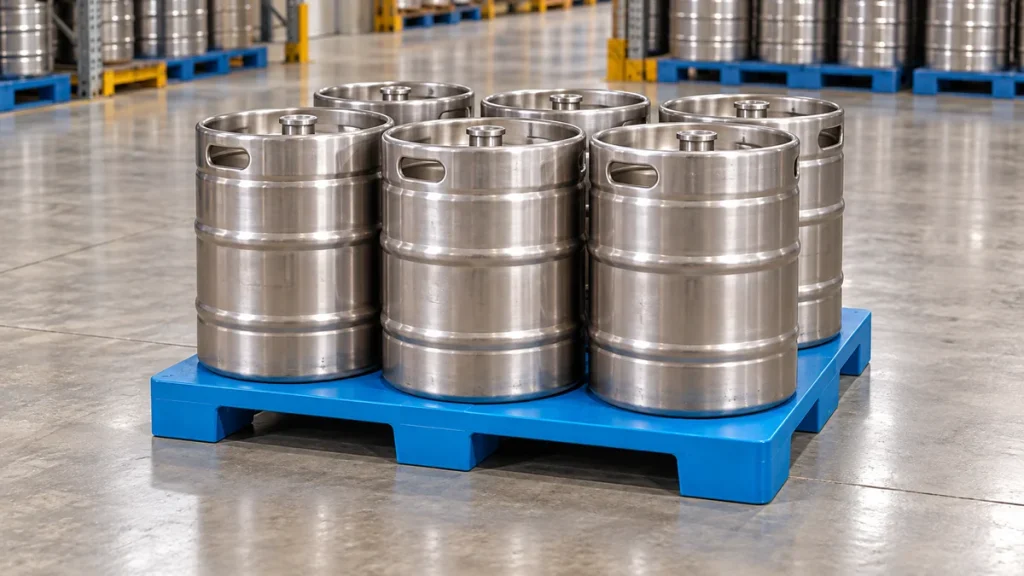
Beverage kegs put a very different load on a pallet from cartons or plastic crates. Their round bases concentrate contact in specific areas, the weight can be substantial, and a small gap in the load pattern can affect stability during movement. Buyers should review the real keg layout and handling route before selecting a plastic pallet.
This guide covers the questions that help a supplier assess a pallet for keg distribution. It does not replace a check with the actual keg type, filled weight, equipment and storage conditions.
Start with the keg footprint
Measure the outside diameter and filled height of the keg. Then show how many kegs sit in each layer and where their bases contact the deck. Round containers leave spaces between units, so a pallet can appear large enough while the actual support pattern is uneven.
The load should sit within the usable pallet area with small, even margins. Kegs that extend beyond the edge are more exposed during turning, vehicle loading and close aisle movement. A top-view layout is useful because it shows the true contact points and the position of every keg in the layer.
Check the deck against the base rings
Kegs transfer load through their base rings rather than across a full carton bottom. The deck must be reviewed against that contact pattern and any layer sheet, mat or locating device used in the daily process. A smooth deck, a grid deck and a double-sided structure can serve different routes, but none should be selected from a photograph alone.
Ask the supplier to compare the actual keg arrangement with the intended pallet structure. The total load figure matters, but it does not describe where the weight enters the deck or how the load behaves when the vehicle stops and turns.
Map the handling route
Write down each stage after filling. A keg load may move from production to a chilled holding area, a dispatch lane, a vehicle and a return point. It may be handled by forklift, pallet jack or another system. Each stage changes the support under the pallet and the way the load is restrained.
Confirm the entry direction and base clearance for the actual equipment. If the route includes racking, provide the beam support details, loaded weight and storage arrangement for a model-specific review. A pallet that performs well on the floor does not automatically suit every rack condition.
Separate full-keg movement from empty returns
Empty kegs and empty pallets can return through a different route from full product. The warehouse may need to reduce the space used by empty pallets, while the outbound load needs stable support for filled kegs. Treat those as two conditions in the selection process.
For the empty-pallet side of the route, our nestable plastic pallets for return logistics guide explains the information that affects return storage. The loaded keg arrangement still needs a separate check.
Review restraint and vehicle movement
Kegs can move if the base pattern, wrap method or vehicle restraint is inadequate. Review the full unit load with the same wrap, straps, separators or other restraint method used in normal dispatch. A short test through ordinary turns, braking and loading activity often shows whether the load pattern needs adjustment.
Also check what happens when the load is partly picked or held in a staging area. A pallet can be stable with a complete layer and behave differently after kegs are removed. If partial loads are common, include them in the operating information sent to the supplier rather than assuming the full-load arrangement covers every condition.
The plastic pallets for food and beverage applications category is a useful starting point for related options. The final choice should follow the keg layout and the route, not the category name alone.
Information to include in an enquiry
- Keg diameter, filled weight, height and quantity per layer.
- Total loaded weight, total height and the full layer arrangement.
- Layer sheets, mats, straps, wrap or other restraint details.
- Forklift, pallet-jack, floor, racking, stacking and vehicle conditions.
- Whether empty pallets return and how they are stored after unloading.
Those details help a supplier compare the real distribution route with a suitable pallet structure. For a separate explanation of the load terms used in these discussions, read our plastic pallet load ratings guide.