
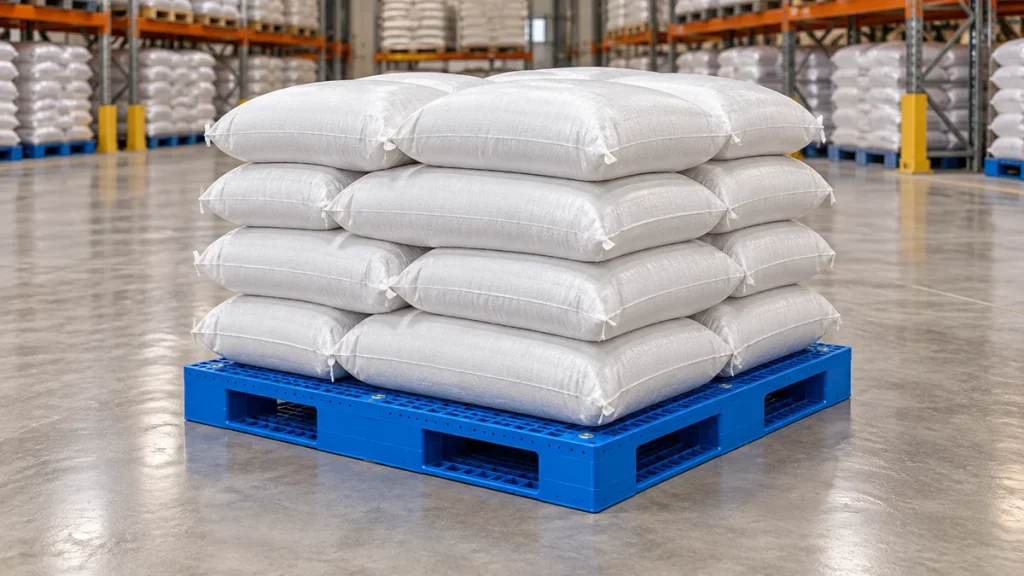
Bagged animal feed can look straightforward on a loading plan, but it creates a demanding unit load. The bags may be flexible, dusty, uneven in shape and sensitive to poor support at the pallet deck. A load that looks stable when it leaves the packing line can shift after repeated forklift transfers or a long vehicle journey.
Buyers should send the real bag dimensions, bag weight, layer pattern and handling route before choosing a plastic pallet. Those details matter more than a general description such as “heavy duty.”
Start with the bag and layer pattern
Record the finished bag width, length and filled weight. Then show the supplier how many bags sit in each layer, whether the pattern changes between layers and how high the finished load will be. Feed bags can compress after filling, so a layout based only on nominal bag dimensions may not show the final footprint.
The outer bags should remain inside the usable pallet area with small, even margins. Bags hanging over an edge are more exposed during loading, turning and close warehouse transfers. A top-view layer drawing is often more useful than a total-weight figure on its own.
Check deck contact as well as pallet size
A bagged load transfers weight through many soft contact areas. That is different from a rigid carton or a drum. The deck needs to support the actual bag pattern and any slip sheet used between the bags and the pallet. Open areas in a deck may be acceptable for one load pattern and unsuitable for another.
Ask the supplier to review the base structure with the full load, not with an empty pallet photo. If the feed is packed in smaller bags, the bottom layer may need a different support pattern from large sacks. The right choice depends on the bag footprint, the layer arrangement and the way the load is handled after packing.
Separate loaded storage from empty-pallet returns
Many feed operations need to balance two different tasks. The loaded pallet must carry the bags safely through packing, storage and dispatch. Empty pallets may then return to a different location. The structure that helps empty-pallet returns is not automatically the best choice for the loaded route.
If the route includes repeated empty returns, compare the available pallet structures against both stages. Our nestable plastic pallets for return logistics guide explains the questions to ask for an empty-return route. The final model should still be selected against the loaded bag pattern and handling conditions.
Map the handling equipment and storage support
List every point where the pallet is picked up or supported. The route may include a forklift, pallet jack, floor storage, a vehicle floor, stacking or warehouse racking. Each stage puts support under different areas of the pallet. A pallet that works on the floor is not automatically suitable for every rack arrangement.
For racking, provide the beam support details, loaded weight and storage arrangement for a model-specific review. For pallet-jack handling, confirm the actual entry direction and base clearance. For loaded stacking, check the height, stability and support condition with the intended pallet structure.
Keep moisture and housekeeping in the discussion
Feed warehouses can have dust, spills and cleaning routines that affect the pallet choice. The decision should reflect the local operating conditions, not a generic claim about a material or deck style. If the same warehouse also handles produce or agricultural inputs, compare the route with the requirements in our agriculture and produce handling buyer guide.
Information to include in an enquiry
- Bag dimensions, filled bag weight and bag material.
- Bags per layer, number of layers, total loaded height and total weight.
- Layer sheets, stretch wrap, corner protection and other load-restraint details.
- Forklift, pallet-jack, floor, racking, stacking and vehicle conditions.
- Whether empty pallets are returned and how they are stored on that route.
With that information, a supplier can compare the real load and route with a suitable pallet structure. For a separate explanation of the load conditions that appear in pallet discussions, see our plastic pallet load ratings guide.