
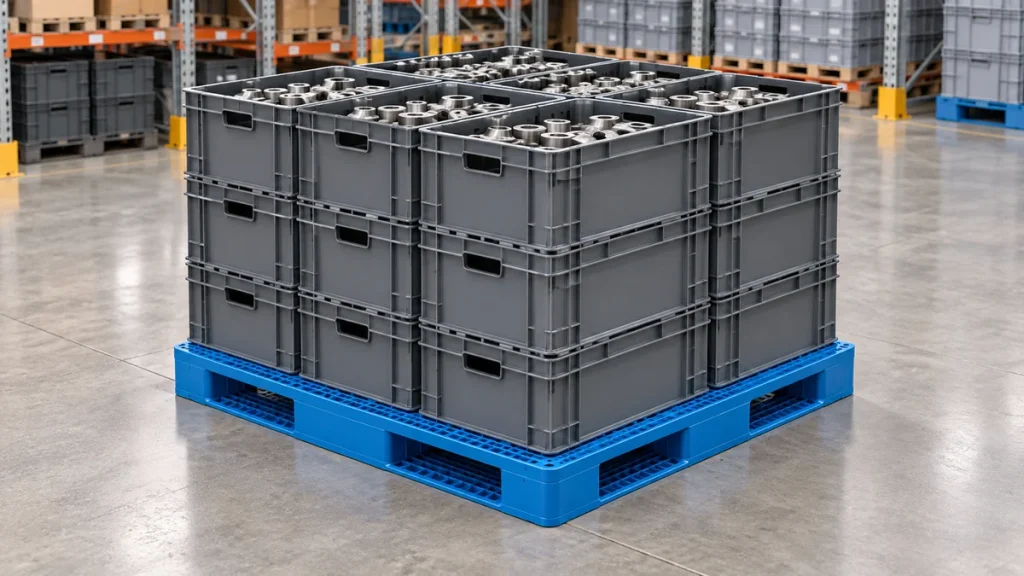
Industrial components are often moved in returnable crates, metal bins or other reusable containers. The pallet may carry parts with very different shapes and weights on the same route. A good selection starts with the container layout and actual support points, not with a general pallet description.
Buyers should provide the container dimensions, the full loaded weight, the number of containers per layer and the handling route. That information lets a supplier assess the selected pallet structure against the real unit load.
Start with the container footprint
Measure the base of each crate or bin and show how it sits on the pallet deck. Some returnable containers have feet, runners or recessed bases that concentrate weight in a few locations. Two containers with the same outside dimensions can create different support conditions underneath.
Keep the outer containers inside the usable pallet area with small, even margins. A crate that overhangs an edge is easier to contact in a narrow aisle or during vehicle loading. A top-view layout should show the base pattern, the gaps between containers and the arrangement for every layer.
Check the deck under the actual contact points
Component crates may be rigid and heavily loaded even when they are not tall. The deck needs to be reviewed against the container feet, runners or base rails. A grid deck, a flat deck or a double-sided structure can suit different routes, but the choice should be based on the loaded crate pattern.
Ask the supplier to review the bottom layer and the full stack. The total load figure alone does not show where the force reaches the pallet or how the containers behave when the unit load is turned or stopped during handling.
Map the handling and storage route
Industrial components may move between production, inspection, warehouse storage, packing and dispatch. Record every place where the pallet is picked up or supported. The route may include forklift movement, pallet-jack movement, floor storage, racking, staging and vehicle transfer.
Each condition can change the support under the pallet. If racking is involved, provide the beam support details, loaded weight and storage arrangement for a model-specific review. A pallet that performs well on the floor does not automatically suit every rack arrangement.
Consider returnable-container circulation
Reusable component containers often circulate between plants, suppliers and warehouses. Empty containers may return nested or stacked, while full containers travel in a different pattern. Review the loaded and empty stages separately so that an empty-return preference does not obscure the support needs of the full load.
Our nestable plastic pallets for return logistics guide explains the information needed for the empty-pallet side of a return route. The selected pallet still needs a separate review with the loaded industrial containers.
Check restraint and partial-load conditions
Stretch wrap, straps, lids or dividers may keep a completed unit load together, but they cannot correct an unstable base pattern. Use the same restraint method that will be used in daily dispatch. Check the load after normal turns, braking and transfers.
Also include partially loaded containers if they occur in regular operation. A pallet can behave differently when one part of the crate pattern is missing or when the center of the load has shifted. The supplier needs that information before recommending a structure for the route.
Keep product facts separate from the pallet review
Component weight, container design and the handling route should be confirmed by the buyer before a pallet recommendation is finalized. If several component families share a pallet pool, do not assume that the strongest or largest example represents every load. Provide the dimensions and normal weight of each regular container pattern.
This approach prevents a pallet decision from being based on a product name, a photograph or a single trial load. It also makes it easier to identify where a separate handling method is needed for an unusual component or container.
Information to include in an enquiry
- Container dimensions, base-foot layout and loaded container weight.
- Containers per layer, number of layers, total load weight and total height.
- Crate lids, dividers, wrap, straps or other restraint details.
- Forklift, pallet-jack, floor, racking, stacking and vehicle conditions.
- Empty-container and empty-pallet return requirements.
Those details help a supplier compare the real component route with a suitable pallet structure. For a separate explanation of common load terms, read our plastic pallet load ratings guide.