
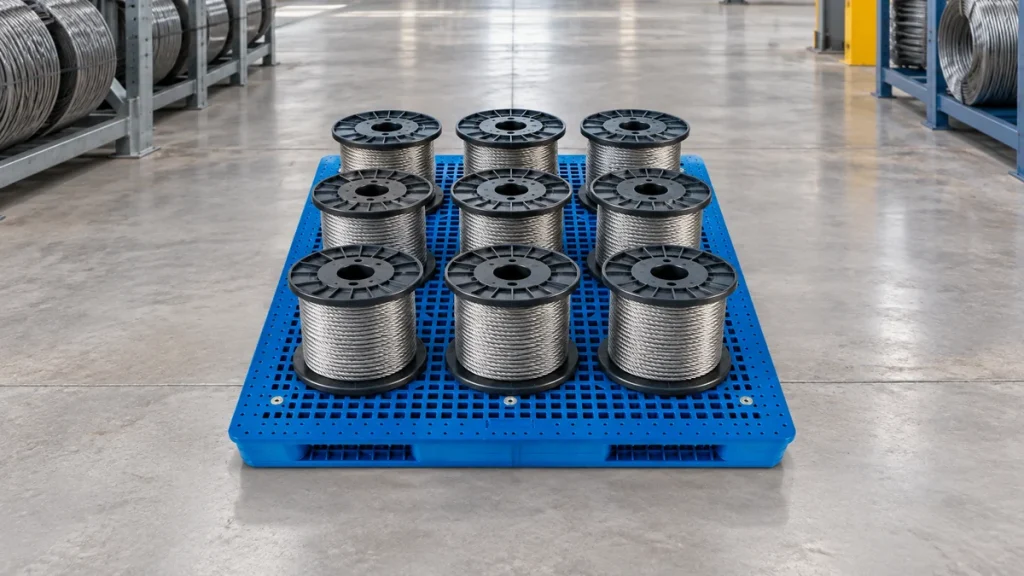
Steel cord is often moved as coils or spools, and those loads do not behave like cartons. The weight is concentrated, the contact points are limited, and a spool can shift or roll if the arrangement is not planned carefully. A pallet that looks large enough is only a starting point.
This guide covers the main checks for selecting plastic pallets for steel cord handling, from spool layout to storage and forklift movement.
Map the spool footprint first
Start with the diameter, width, gross weight and base shape of each spool. Then draw the planned pattern on the pallet. The total weight matters, but so does where that weight lands. A group of spools can create concentrated contact areas and leave the deck carrying an uneven pattern.
Check the clearance at every edge. A spool should not sit partly beyond the deck simply because the overall pallet size appears close enough. The layout should also leave enough room for the intended restraint method and for safe access during loading.
Review deck contact and support
The deck must support the real contact points beneath the spools. An open grid deck can be appropriate where the spool base and support pattern have been reviewed for that structure. A flat deck may be preferred where a broader contact surface is required. Neither style is automatically right for every spool.
Do not rely only on a general load figure. A load rating can describe a particular condition, while the actual steel-cord arrangement may have a different distribution. Provide the supplier with the filled pallet pattern, individual spool weights and the required storage method.
Prevent rolling and lateral movement
Spools need a clear restraint plan. Depending on the spool construction and the operating route, that may involve locating features, separators, blocking, wrap or another method validated for the actual load. The purpose is to keep every spool in place without damaging the cord or obstructing handling equipment.
Include the difficult moves in the review. Starts, stops, turns, dock plates and uneven floor joints can expose movement that is not visible while the pallet is stationary. A trial should follow the normal route rather than a single vertical lift.
Match the pallet to the handling route
Confirm the forklift entry direction, fork length, fork spacing and expected load centre. These details influence how the loaded pallet is supported during movement. If the site uses a different handling method at another stage, check that method separately instead of assuming one solution works throughout the route.
Storage also needs its own review. Floor storage, elevated support and stacking create different conditions. If the load will be placed on a rack or another raised structure, provide the real support layout, span and loaded pallet arrangement. A pallet suitable for a supported floor position is not automatically confirmed for every elevated-storage condition.
Check housekeeping and reuse conditions
Steel-cord handling areas can have dust, wire debris and frequent equipment traffic. Review cleaning practice, deck openings and the route used by empty pallets. The selected pallet should suit the handling process as well as the loaded move.
For returnable flows, document how empty pallets are stored and collected. Empty handling can be very different from loaded handling, particularly when pallets are nested, stacked or transferred between work areas.
Test the real unit load
Before a wider rollout, test a pallet with the actual spools, the intended restraint method and the normal equipment. Record the pattern, total load, fork entry, storage position and observations from the route. Check for spool movement, deck contact, pallet deflection and equipment clearance.
A short trial record gives the purchasing team a clear basis for comparing options. It also stops a generic pallet description from being treated as confirmation for a spool layout that has never been assessed.
Buyer checklist
- What are the dimensions and gross weight of each steel-cord spool?
- Where will each spool sit on the pallet deck?
- How will the spools be prevented from rolling or shifting?
- Which equipment will handle the loaded pallet?
- Will the load be floor-stored, elevated or both?
- What deck contact and cleaning requirements apply?
- Can the final layout be tested on the real route?
The best plastic pallet for steel cord handling is one that supports the actual spool layout and remains stable through the complete handling route. Start with the load drawing, then test the selected structure under the real operating conditions.