
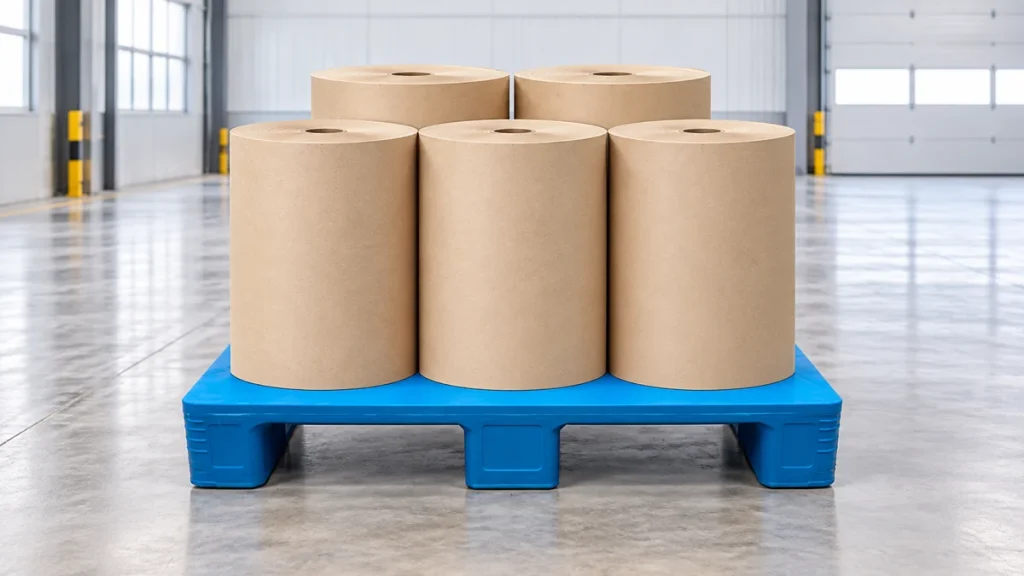
Paper rolls put a different kind of demand on a pallet. The load is round, heavy, and often tall enough that a small shift becomes noticeable during a move. A pallet selected only by its rated load or overall size can still be a poor fit if the roll footprint, deck contact and handling route have not been checked together.
This guide gives purchasing and warehouse teams a practical way to review plastic pallets for paper roll handling before placing an order.
Start with the roll geometry
Record the roll diameter, width, core diameter, weight and planned arrangement on the pallet. The useful load footprint is not always the same as the outside dimensions of the pallet. A roll placed close to an edge can change the load balance, while gaps between rolls can leave parts of the deck carrying more weight than expected.
For upright rolls, the contact area at the base of each roll matters. For rolls transported on their side, the risk is different: they need to be restrained from movement and the support arrangement should be reviewed with the actual handling method. Draw the load pattern before comparing pallet models.
Check deck contact and load distribution
A flat deck gives broad support under the base of a roll. That can be useful when the load needs a more continuous contact surface. An open deck may also be suitable where the roll base, support pattern and protection method have been assessed for that design.
Do not assume that a high static-load figure answers every question. Static load applies when the pallet is at rest on a supported floor. Movement, uneven surfaces, edge contact and an uneven roll pattern change the condition. Give the supplier the loaded pattern rather than only the total weight.
Separate storage from handling
Paper rolls can move through several conditions in one shift: floor staging, forklift transfer, pallet-jack movement, a loading dock or a vehicle. Each condition puts support under different areas of the pallet. Confirm the equipment, entry direction, fork dimensions and expected travel surfaces.
If the loaded pallet will be stored on beams or another elevated support arrangement, review that use separately. Racking suitability depends on the real support points, span, load distribution and pallet design. A floor-storage application does not prove that the same model is appropriate for a rack.
Control movement before it starts
Round loads need a clear restraint plan. Depending on the packaging and route, that may include wrap, edge protection, roll chocks, separators or another method that has been tested with the actual load. The purpose is to keep the rolls in their intended position without damaging the paper surface or creating a handling obstruction.
Ask where the highest-risk moves occur. A fast forklift turn, a dock plate or an uneven floor joint may reveal a weakness that is invisible when the load is standing still. The trial should include the normal route, not only a straight lift from the warehouse floor.
Consider moisture, dust and reuse
Paper products can be sensitive to moisture and surface contamination. The right pallet choice depends on the production area, warehouse conditions and cleaning practice. Plastic pallets can be cleaned, but the selected design still has to fit the operation. Review drainage, the required contact surface and whether the pallet will return through a controlled process.
Reuse also affects the decision. A pallet used repeatedly between a mill, converter, warehouse and customer should be reviewed for the way it is collected, stored empty and reintroduced to the line. Empty handling should be planned separately from loaded handling.
Run a representative trial
Before a larger rollout, test the proposed pallet with the actual paper rolls, packaging and equipment. Record the roll pattern, total weight, restraint method, storage condition and the moves completed. Check for deck contact, roll movement, pallet deflection and clearance at the equipment interface.
A short trial record helps both sides discuss whether the deck, base or protection method needs to change. It also prevents a general pallet description from being treated as confirmation for a load that has not been reviewed.
Buyer checklist
- What are the actual diameter, width and weight of each roll?
- How many rolls will be placed on one pallet, and where will they sit?
- Does the selected deck support the roll bases where they contact it?
- Which equipment will move the loaded pallet?
- Will the pallet be floor-stored, rack-supported or both?
- What restraint and surface-protection method will be used?
- Can the final arrangement be tested on the real handling route?
For paper roll handling, the best pallet is one that fits the roll pattern and the full route from storage to loading. Start with the load drawing, confirm the support conditions and test the complete unit load before standardising the specification.