
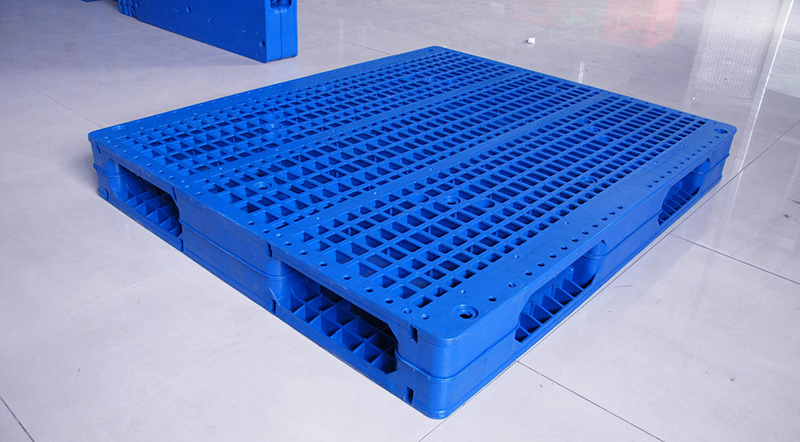
A plastic pallet may be described with three different load figures: static, dynamic and racking. They are not three ways of stating the same capacity. Each figure belongs to a different support and handling condition.
This distinction matters when buyers compare quotations. A pallet that carries a heavy load on a flat floor may behave very differently when it is lifted by a forklift or supported only across warehouse rack beams. The number on a data sheet is useful only when its test or operating condition matches the way the pallet will actually be used.
This guide explains what the three ratings mean, why they cannot be exchanged, and what information to send a supplier before choosing a plastic pallet.
One load number cannot describe every job
The load on top of a pallet is only one part of the problem. The pallet also needs support underneath. A warehouse floor supports most of the base. Forklift tines support only narrow areas while the pallet is being moved. Rack beams may support two strips near the pallet edges, leaving a large unsupported span in the middle.
Those conditions produce different stresses and different amounts of deflection. They also explain why a higher static rating does not automatically mean a pallet is suitable for racking.
When comparing two models, first ask which handling condition each number describes. Then confirm how the load was distributed and how the pallet was supported. Without that context, a large capacity figure can be misleading.
What static load means
Static load describes a loaded pallet at rest on a flat, solid and level surface. Because the floor supports a large part of the pallet base, this is normally the least demanding of the three conditions.
A static rating is relevant when loaded pallets are stored on the floor or stacked, but stacking adds another question: how the upper pallet transfers its weight to the pallet below. Concentrated feet, uneven cartons or a load that overhangs the deck can create local pressure that is not represented by the total weight alone.
Static load should therefore be checked together with the package layout. Tell the supplier whether the cargo is in cartons, bags, drums, rigid bins or another format, and whether the weight is spread evenly across the deck.

What dynamic load means
Dynamic load describes a pallet carrying goods while it is being handled, usually by a forklift or pallet truck under the conditions stated by the supplier. During movement, the pallet is not supported across its full base. The tines, deck structure and load distribution all affect performance.
Acceleration, braking, turning, floor joints and impacts can increase the stress compared with a pallet standing still. Fork length and tine spacing matter as well. Tines that do not enter far enough, or that support the pallet in the wrong areas, can change the load path.
Equipment compatibility must be checked separately from the dynamic number. A double-sided pallet, for example, may not suit a standard hand pallet truck because its lower deck can interfere with the truck’s load wheels. A dynamic rating does not remove that physical limitation.
Why racking load needs separate confirmation
Racking load applies when the pallet is stored above the floor with limited support, such as two rack beams. In this condition, the unsupported span can bend under the payload. Rack span, beam position, pallet orientation, load distribution, temperature and storage time can all affect deflection.
For this reason, a supplier should not infer a racking value from the static or dynamic rating. The proposed pallet needs to be checked against the actual rack arrangement. Start with the clear span between supports and note whether the pallet is supported on two beams, multiple rails or another structure.
The pallet base also needs to match the application. Six-runner, three-runner and reinforced structures may provide different support paths, but the structure name alone is not proof of a particular racking capacity. Buyers comparing rackable plastic pallet options should confirm the loaded condition for the specific model.

Why published ratings cannot be swapped
The support changes
A pallet on the floor is supported very differently from a pallet on two rack beams. The same payload can produce much more bending when the middle of the pallet is unsupported. This is the main reason static capacity cannot be treated as racking capacity.
The load distribution changes
A uniformly distributed load is easier on the deck than the same total weight concentrated in a few small areas. Drums, machine components, bulk bags and rigid feet each load the pallet differently. Overhang can also move weight beyond the intended support zone.
Handling and environment change
Temperature, handling frequency and time under load can influence plastic pallet behaviour. A pallet used for occasional indoor movement does not face the same conditions as one moving through cold storage, uneven yards or repeated automated cycles. These details belong in the selection discussion, even if the requested payload is unchanged.
A practical way to compare two pallet models
Consider two published products on this site. The 1200×1000 food-grade six-runner pallet lists a static load of 3,000 kg and a dynamic load of 1,000 kg. The 1400×1200 heavy-duty six-runner pallet lists 6,000 kg static and 2,000 kg dynamic.
Those figures help compare floor storage and handling within the stated product information. They do not establish a racking load. Neither published specification provides a racking figure, so the safe next step is to provide the rack span, support arrangement and payload details for model-specific confirmation.
The same approach applies to any quotation. Compare like with like: static with static, dynamic with dynamic, and racking with racking under matching support conditions. If one supplier gives only a single number, ask what condition it represents.
Information to send before asking for a recommendation
A useful pallet recommendation starts with the operating conditions. Send as much of the following information as you can:
- Maximum gross load on one pallet
- Cargo type, dimensions and number of packages
- Whether the load is uniform, concentrated or likely to overhang
- Required pallet dimensions and entry direction
- Floor storage, stacking, racking or a combination of these
- Rack clear span, beam width, support points and pallet orientation
- Forklift, hand pallet truck, stacker or automated handling equipment
- Typical travel route and handling frequency
- Operating and storage temperatures
- Expected time under load
- Cleaning, hygiene or contamination-control requirements
Photos or drawings of the rack and the existing load layout are often more useful than a short message asking for a “two-ton pallet.” They show where the pallet is supported and where the weight is applied.
Questions to ask when a supplier gives a load rating
Ask which support condition was used, how the payload was distributed and whether the figure is a nominal rating, a maximum test result or a recommended working load. Also ask whether temperature, duration and repeated handling were considered.
The current ISO 8611 series separates pallet test methods, performance requirements and maximum working loads. ISO notes that laboratory load-capacity tests do not replace field tests for a specific pallet design. Buyers do not need to reproduce the standard, but they should expect a supplier to describe the basis of a rating clearly. See the official summaries for ISO 8611-1:2025 and ISO 8611-2:2025.
If the pallet will be used in beam racking, the separate guide on what to check before beam racking covers the rack information that should be confirmed before ordering.
Choose from the real operating condition
Static, dynamic and racking ratings answer different questions. Start with where the pallet is supported, how the load is distributed and how it will be moved. Once those details are clear, the published figures become useful rather than confusing.
For a model recommendation, send Zhenghao Plastics the payload, handling method and rack or stacking arrangement. We can then compare suitable structures without treating one load number as a guarantee for every application.