
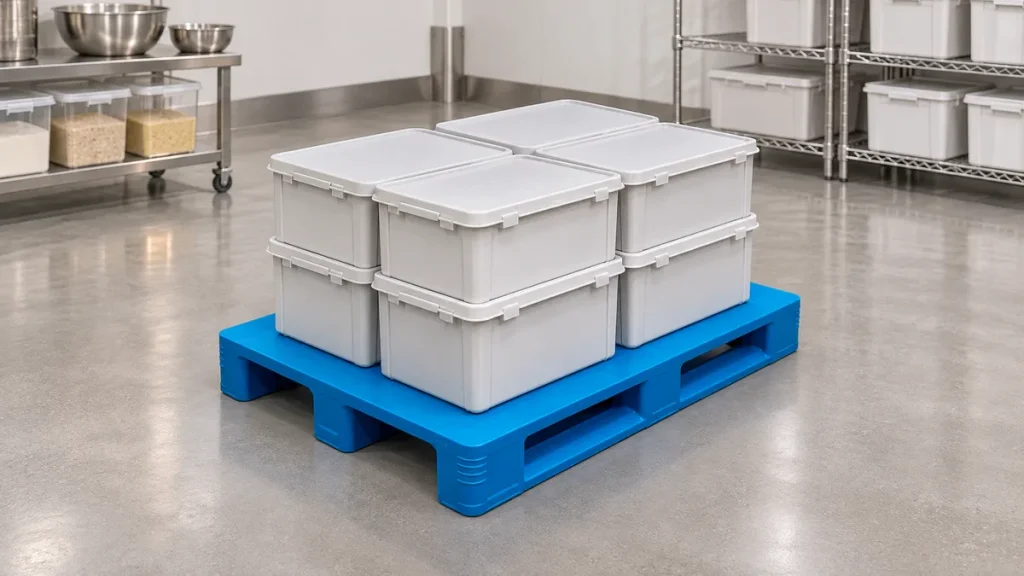
Returnable ingredient bins change the way a food warehouse should evaluate a pallet. The load reaches the pallet through the bin feet or base rim, rather than across the whole deck. A pallet that looks large enough from above may still leave a bin foot close to an edge or an unsupported area.
Before requesting a quote, measure the bins in their loaded condition and draw the proposed arrangement on the pallet. The useful questions are where the bins contact the deck, how operators move the unit load and what happens when the empty bins and pallets return.
Find the real contact points
Turn one bin over and inspect its base. Some bins sit on a continuous rim; others have four feet or molded ribs. Mark these contact points on a top-view drawing of the pallet. If a foot lands near a deck opening or between structural ribs, the pallet size alone cannot resolve the problem. Test the bin with its normal contents, since a loaded bin can flex differently from an empty one.
A closed or flat deck offers a more continuous surface for bin bases. That can make the contact pattern easier to evaluate, but the deck still needs to suit the actual bin, load and handling route. Check for overhang and for contact between adjacent bins. A neat arrangement of empty bins is not a substitute for a loaded trial.
Review the stack, not only the bottom layer
Returnable bins are often stacked with a lid or interlocking rim. Confirm the permitted stack height from the bin supplier and inspect the loaded stack after a short move. A stable bin stack depends on the bin design, lid fit and weight distribution as well as the pallet. If different bin sizes share the same pallet, test each common pattern rather than relying on one example.
Pay attention to the outer corners. A small amount of overhang can become more noticeable when a forklift turns or a vehicle brakes. If stretch wrap or straps are used, record them in the trial. The restraint should be part of a documented unit-load method, not an improvised correction for poor base support.
Match the base to the equipment
List every move between filling, storage, dispatch and return. Fork spacing, tine length and entry direction should be checked with the loaded pallet. If a pallet jack is used, inspect the wheel path under the exact base and the clearance as its wheels leave the pallet. A visible entry opening does not prove compatibility with every truck.
For racking, ask for a model-specific assessment using the actual beam spacing, support direction and load distribution. A pallet supported across its full footprint on the floor faces a different condition from one resting on rack beams. The same care applies to conveyors and automated equipment, where runner location and pallet dimensions must match the system.
Specify cleaning and return requirements
The bin and pallet may follow different cleaning schedules. Ask the site team where residue accumulates and how each item is washed, dried and inspected. A smooth deck can simplify visual inspection of its top surface, while underside cavities and joints still need attention. Avoid assuming that a product name supplies the hygiene documentation required by a particular food process.
When the loop includes an empty return, compare the space taken by both empty bins and pallets. A stackable bin can save space in one part of the loop while the chosen pallet base limits how many empty pallets fit in the vehicle. Measure the actual return configuration and consider damage inspection before the next use.
Use a real model as a starting point
The SINOPALLETS 1200×800 flat-deck three-runner pallet is one real product that a buyer can compare against a bin layout. Its flat deck makes it a useful structural reference; this article does not assert that it fits every bin or handling system. The food and beverage pallet category provides other models for a shortlist.
Send suppliers the bin base drawing, loaded weight, pallet pattern, handling equipment, storage support and cleaning requirements. Request confirmation for the exact configuration being offered, then test a representative loaded unit. Those steps turn a general request for a food pallet into a usable purchase specification.