
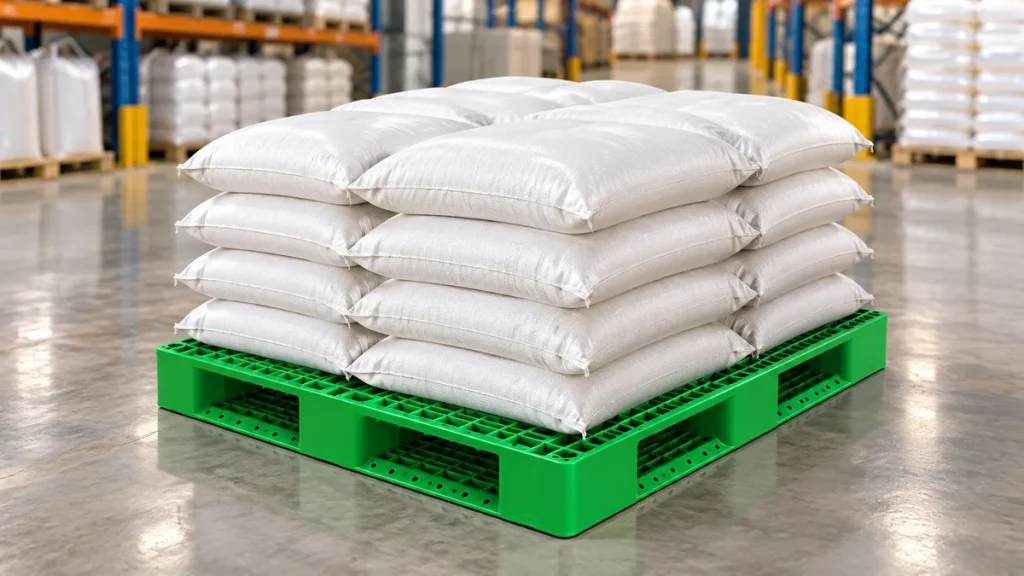
Bagged food ingredients look straightforward on a pallet, but the handling route can expose weaknesses that are not obvious at the loading point. Flour, sugar, starch, salt and similar dry ingredients may arrive in woven sacks, paper sacks or lined bags. Their footprint changes as they settle, and a load that looks square can spread at the edges after transport or repeated handling.
For this reason, a pallet should be chosen from the actual bag pattern and operating route, not from a generic food-industry label. The right review starts with the base of the bags, the support offered by the deck, the way the load is stabilized, and the equipment used from receiving to dispatch.
Map the bag footprint before selecting a deck
Lay out the intended bags on a drawing that matches the pallet size. Note whether every bag has support below it, whether the corners of the layer overhang, and whether the pack changes once the bags settle. A sack can bulge past its nominal dimensions, especially when stacked under compression. That affects edge support and can make stretch wrap appear to be doing more work than it should.
A grid deck can work well when the bags and any intermediate sheet have adequate contact over the deck. A flat deck offers more continuous support under the load base. Neither description alone decides the result. The buyer should test the real bag material, fill level and layer pattern. If an intermediate slip sheet is part of the process, include it in the trial rather than assuming it will solve an unsuitable layout.
Check the loaded stack as a system
Bagged ingredients are often stacked in interlocking layers. The stack height, bag orientation and wrap pattern all affect stability. Build one representative unit load and inspect it after a short move, a turn and a pause on the floor. Look for shifted bags, compressed corners and any layer that begins to spread outside the pallet footprint.
Do not treat a pallet’s static load figure as a description of every stacked bag arrangement. Floor flatness, load distribution and the condition of the bags are part of the result. If the load will be stored in a rack, confirm the exact pallet configuration, support direction, beam spacing and tested rating with the supplier. A pallet that performs on a full floor support does not automatically suit a beam-rack application.
Follow the forklift and pallet-jack route
The transfer route should be reviewed with the equipment operators. Confirm fork spacing, tine length, entry direction and the clearance beneath the loaded pallet. For pallet-jack use, inspect the wheel path and the way the front load wheels pass under the base. An opening visible from one side is not enough evidence that a particular truck and loaded pallet will work together.
Also include vehicle loading. Sudden braking, uneven dock plates and repeated transfers can shift sacks even when the stack looked stable at the packing line. Where a route includes conveyors, racking or automated equipment, ask for a model-specific review rather than carrying over assumptions from another pallet family.
Keep food-process requirements specific
Food-related handling may require a cleaning routine, a particular inspection practice or a closed load surface. Those requirements belong in the specification. Avoid assuming that a product named for food use carries every certification or hygiene characteristic a site may require. Ask the supplier to confirm the relevant material, construction and documentation for the exact model being quoted.
The plastic pallets for food and beverage applications category can help buyers shortlist suitable designs. One listed example is the 1200×1000 six-runner plastic pallet, but its suitability still depends on the bag layout and handling conditions.
What to include in an RFQ
Give the supplier the pallet footprint you need, bag dimensions when filled, the layer pattern, total loaded height, expected handling equipment and storage method. Include photos or a simple top-view drawing of the proposed unit load. State whether the pallet will be used on the floor, in a rack, in a vehicle or across several of those conditions.
That information makes it possible to compare real models without claiming capacity or compatibility that has not been verified. A practical selection is one that supports the bags, fits the route and can be checked with the same configuration that will be ordered.