
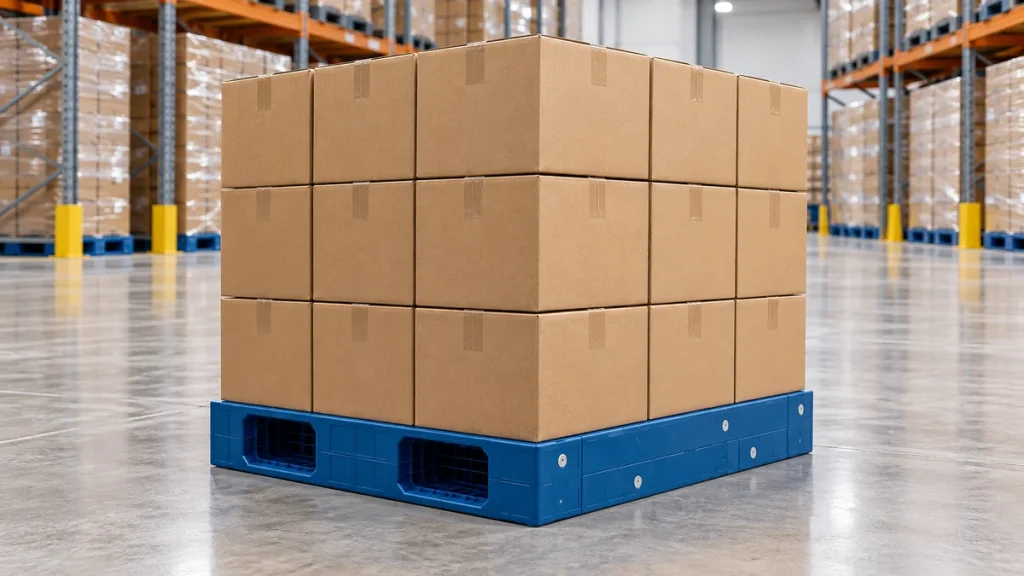
Fork entry affects where a pallet can be picked up, turned and placed. Buyers often see “two-way” or “four-way” in a specification and treat it as a simple preference. In practice, the right entry arrangement depends on the equipment, aisle layout, pallet base and the direction in which the load moves through the site.
This guide explains what buyers should confirm before choosing a two-way or four-way entry plastic pallet. The entry description is only one part of the decision. The full unit load and support conditions still need a model-specific review.
What two-way and four-way entry describe
Two-way entry means the pallet is designed to be picked up from two opposite sides. Four-way entry means the design provides access from all four sides. The practical result depends on the actual opening dimensions, the fork equipment and the pallet base.
Do not assume that every piece of handling equipment can use every visible opening. Forklift tines, pallet-jack forks and stacker equipment have different clearances and approach requirements. Confirm the equipment used at the site before treating an entry description as a final answer.
Map the approach direction at each handling point
Start with the loading area, warehouse aisles, production line and vehicle. Note the direction from which operators normally approach the pallet. A route with wide forklift aisles may work with a different arrangement from a route that relies on close pallet-jack movement at a dispatch door.
Also record whether the same pallet is turned during the route. A pallet may leave production in one orientation and arrive at storage or dispatch in another. Four-way access can give more flexibility in some operations, but that does not remove the need to check the base structure and the real handling equipment.
Check pallet-jack use separately
Pallet-jack handling should be checked against the exact pallet design. The wheels, fork clearance and entry path can be affected by runners, blocks, deck shape and the position of the load. A pallet that can be lifted by a forklift is not automatically suitable for pallet-jack movement from every side.
Our plastic pallet jack handling guide lists the route details that should be shared with a supplier. Provide photos of the normal approach where possible, especially when the pallet is picked up in a confined area.
Review the entry with the loaded pallet
The load can change the usable approach. Cartons, totes or other units that overhang the pallet edge may block fork access or be struck during entry. Keep the load inside the usable deck area with small, even margins, and check the full load during normal lifts and turns.
If the load uses a slip sheet, wrap or corner protection, include those items in the review. They can change the outer dimensions of the unit load. A clear top-view layout and side-view photo give the supplier a better basis than a pallet size alone.
Allow for shared equipment and changing routes
Some sites use the same pallet pool across several departments. One department may use a forklift, while another relies on pallet jacks or a different aisle direction. List every route that the pallet will take, including transfers to third-party transport or a return warehouse. A choice made for one department can create avoidable handling delays elsewhere.
When the route changes seasonally or by customer, identify the handling condition that sets the limit. That may be the narrowest aisle, the least forgiving entry direction or the heaviest normal unit load. The supplier can then review the actual requirement instead of recommending from entry count alone.
Do not use entry count to decide racking suitability
Fork entry and racking suitability are separate questions. Racking depends on the selected pallet structure, the beam support, the loaded weight and the storage arrangement. A four-way pallet is not automatically suitable for a particular rack system, and a two-way design is not automatically excluded.
If racking is part of the route, share the rack beam details and the full load information. The rackable plastic pallets guide explains the information needed for that separate review.
Information to include in an enquiry
- Forklift, pallet-jack or other equipment type and fork dimensions.
- Required approach directions at production, storage, dispatch and vehicle loading.
- Load footprint, total weight, total height and any overhang risk.
- Floor, racking, stacking and vehicle conditions.
- Photos or drawings of tight handling areas and normal pallet orientation.
Those details let a supplier compare the route with a suitable pallet structure and entry arrangement. For a separate explanation of common load terms, read our plastic pallet load ratings guide.