
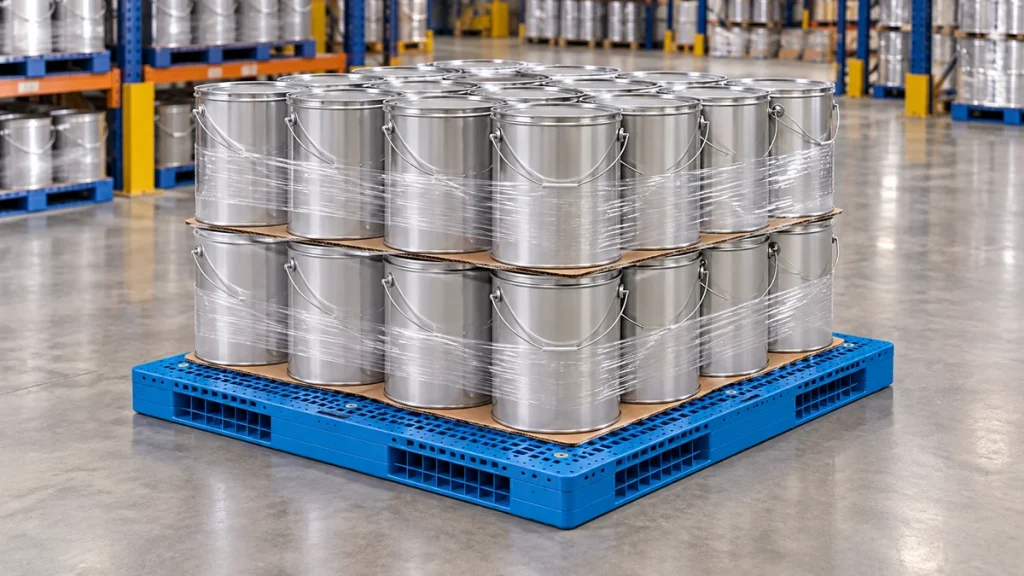
Paint and coating containers create a different pallet load from ordinary cartons. The units may be metal or plastic cans, pails or drums. Their round bases concentrate weight at specific contact points, and the finished load can become tall quickly. Buyers need to look at the container pattern, the handling route and the storage arrangement before selecting a plastic pallet.
This guide covers the information that helps a supplier review plastic pallets for paint and coating container loads. It does not replace a test with the real containers, loaded weight and handling equipment.
Start with the container footprint
Measure the outside diameter or width of each filled container and show how it sits in the layer. Round cans can leave open areas between units. Pails with handles may need extra clearance. A layer sheet or a tray may change the contact area again. The useful question is not whether the pallet is large enough in general, but whether every container rests on a stable part of the load pattern.
Send the supplier a top-view layout with the number of containers per layer, the total number of layers and the loaded height. The pattern should remain inside the usable pallet area with small, even margins. A can or pail that extends beyond the edge is exposed during vehicle loading and close warehouse transfers.
Check the deck against actual contact points
Containers transfer weight through their base rings or flat bottoms. If the load uses a layer sheet, the sheet also needs enough support to avoid sagging. A grid deck, a flat deck or a double-sided structure can each suit different applications, but the deck should be assessed with the real container pattern. Do not select a pallet only because its total load figure appears high enough.
For stacked loaded pallets, the upper pallet and the lower load must be considered together. A double-sided pallet may be relevant for some stacking routes, but the actual stack height, support condition and load stability still need to be checked for the selected model.
Separate normal handling from containment needs
A standard load-carrying pallet and a spill-containment pallet have different jobs. A normal pallet supports and moves the unit load. Secondary containment is a separate requirement when the operation needs to collect a leak or drip. If the route needs that function, review the spill containment pallet options as a separate product decision rather than treating every chemical-container pallet as a containment unit.
Map the real handling route
Write down each handling stage after filling. The load may be moved by forklift, stored on the floor, placed in racking, stacked, transferred to a vehicle or held in a dispatch area. Each step changes where the pallet is supported and how the container load behaves.
Forklift entry, pallet-jack use, racking support and loaded stacking should be checked against the exact base structure. A pallet that works in a floor-storage route is not automatically suitable for every rack arrangement. If racking is involved, provide the beam support details and the actual loaded weight for a model-specific review.
Review wrap, sheets and load stability
Stretch wrap can help hold a finished load together, but it does not compensate for gaps, loose containers or an unstable layer pattern. Check the load after turns, braking and transfers. Use the same layer sheets, corner protection and wrap method that will be used in daily operation. A short trial often reveals whether the pack pattern should change before pallets are ordered.
The plastic pallets for chemical and paper applications category is a useful place to review related options. The final choice should still follow the container layout and handling route, not the category label alone.
Details to include in an enquiry
- Container type, outside dimensions and filled weight.
- Containers per layer, layer sheets, total layers and loaded height.
- Total load weight, wrap method and any corner protection.
- Forklift, pallet-jack, floor, racking, stacking and vehicle conditions.
- Whether secondary containment is required as a separate function.
Those details allow a supplier to match a real pallet structure to the load instead of making a general recommendation from the product name. For a separate explanation of the different load conditions, read our plastic pallet load ratings guide.