
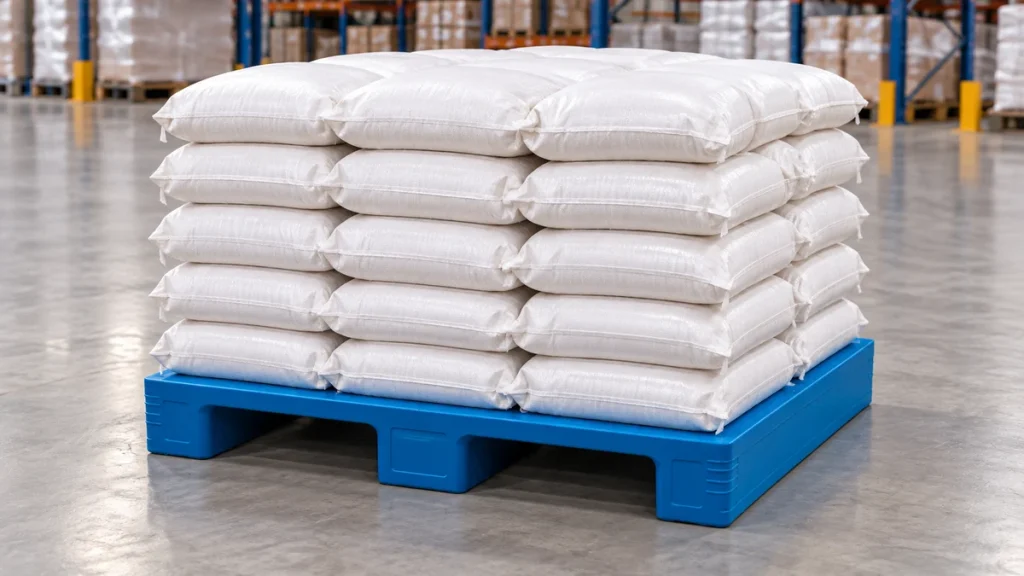
Bagged materials look straightforward on a pallet, but the load can behave very differently once it is moved, stacked or stored for more than a short time. Fertilizer, powders, resins, grain ingredients and other dry materials may arrive in woven bags with different fill levels, surface friction and bag shapes. A pallet that looks suitable under a neat sample load may not suit the actual handling route.
This guide helps buyers prepare the right questions before choosing plastic pallets for woven bag loads. It does not replace a load test. It helps define the information a supplier needs before recommending a structure.
Start with the real bag pattern
Ask how bags will sit on the pallet as well as how much the complete load weighs. Record the bag length, width and filled height, then show the intended layer pattern. A square footprint can leave unsupported areas when narrow bags are placed in the same direction. An uneven layer can also transfer more load to one side of the deck.
The usable deck should be covered with a stable pattern and small, even safety margins. Cargo should not overhang the edge. Overhang exposes bags to impact and can make stretch wrapping less predictable. A large unused border is not a good substitute for checking the actual bag layout.
Check deck contact before choosing a structure
Woven bags are flexible. They can settle into large deck openings, especially when the product stays on the pallet for a long period or when lower bags carry the weight of upper layers. A closed or flatter deck can give broader contact for many bagged loads. An open deck may still be appropriate in some operations, but the bag material, layer pattern and support points should be reviewed together.
For bagged chemical or paper-related materials, buyers can begin with the plastic pallets for chemical and paper applications category, then compare the actual deck and base structures against their loading plan.
Separate floor, forklift and rack conditions
A pallet may be moved on the floor, lifted by forklift and held on warehouse racking during the same route. Those are different conditions. The load on the deck is only part of the question. The base structure, support method and handling equipment also matter.
Describe the route in order: where the bags are loaded, whether a pallet jack is used, how the forklift enters, whether the pallet is placed on beams, and whether loaded pallets are stacked. Do not assume that a pallet suitable for floor storage is automatically suitable for every rack or stacking arrangement. When racking is part of the route, share the beam support details and the actual loaded weight for a model-specific review.
Look at layer stability, not only total weight
The number of layers affects the shape of the load. A tall stack of soft bags can shift when accelerating, braking or turning. Interlocking patterns may help in some cases, while other bag shapes need a consistent orientation. The right approach depends on the bag construction and whether the load is wrapped, strapped or protected with a top sheet.
Give the supplier a simple drawing or photo of the intended load. It should show bags per layer, number of layers, total height, wrapping method and any top frame or corner protection. This is more useful than a request for a “heavy-duty pallet” without operating details.
Ask about the full operating environment
Moisture, dust, cleaning routines and temperature can change the selection. If bags are handled near wet production areas, drainage and cleaning may be relevant. If the pallet is used in a dry warehouse, a different priority may be deck support, fork entry or repeat handling. Reusable routes also need a plan for empty-pallet storage and return transport.
Information to send before requesting a recommendation
- Bag dimensions, filled bag weight and material.
- Bags per layer, layer pattern, number of layers and total load height.
- Total loaded weight and the expected storage time.
- Forklift, pallet-jack and rack conditions, if applicable.
- Whether loads are wrapped, strapped or stacked.
That information lets a supplier compare real pallet structures against the route instead of selecting by footprint alone. The same pallet size can have very different deck and base designs. For a broader explanation of how load conditions affect pallet selection, see our plastic pallet load ratings guide.