
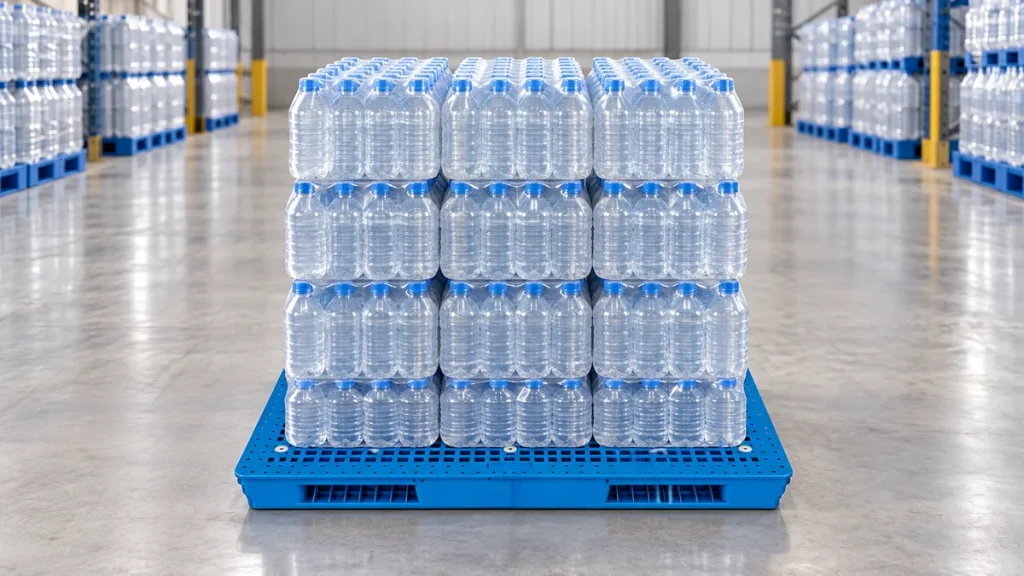
Bottled-water loads look regular, but the handling route can still expose weak points. Shrink-wrapped packs can bridge deck openings, tall stacks can move under braking, and a pallet that works on the floor may not suit every storage arrangement. Buyers should review the complete unit load instead of choosing from a product photo alone.
This guide explains what to check when selecting plastic pallets for bottled-water distribution.
Start with the pack pattern
Document the bottle size, pack footprint, packs per layer, layers per pallet and total gross weight. The outer packs matter as much as the centre of the load. If packs overhang the deck or sit above unsupported areas, the shrink wrap may carry more of the load than intended during movement.
A top-view drawing is useful here. It shows where each pack contacts the pallet deck and where any gaps occur. That simple drawing gives a supplier more useful information than a request for a general heavy-duty pallet.
Check deck support under the packs
The deck should support the actual pack bases. A continuous surface can be useful where the load needs broad contact. An open deck can also be suitable when the bottle-pack base, shrink-wrap pattern and support layout have been checked for that design.
Do not treat a general static-load figure as proof for every case. Static load refers to a pallet at rest on a supported floor. A tall water load during travel, a partly filled pallet or an uneven pack arrangement produces a different condition.
Separate storage from transport
Bottled water may move from a production area to floor staging, a loading dock and a truck. Each step has different support and stability demands. Confirm the entry direction, fork dimensions, load centre and the travel surfaces for the equipment that will actually be used.
If loaded pallets will be placed on racks or another elevated support arrangement, review that use independently. The support layout, span, load distribution and pallet design all matter. A pallet suitable for a supported floor position is not automatically confirmed for every elevated-storage condition.
Review stack stability and wrap quality
The pallet is one part of the unit load. The pack pattern, layer alignment, wrap tension and any edge protection affect stability as well. Check the normal height of the load and whether the outer packs remain aligned after a turn, a stop or a dock transition.
Do not use an unusually neat trial stack as the only reference. Test the common production pattern, including the pack variation and handling route that the site uses every day.
Account for wet areas and reuse
Water distribution can involve wet floors, condensation, washdown or outdoor transfer points. Review cleaning practice and drainage needs alongside the load requirements. Plastic pallets can be cleaned, but the selected design still has to match the operating environment.
For a returnable system, also check the empty-pallet route. Empty collection, storage and transfer may use different equipment from the loaded pallet flow.
Run a representative trial
Before standardising a specification, test the proposed pallet with real filled packs. Include normal starts, stops, turns, dock plates and the intended storage position. Record the pack pattern, total load, equipment used and any observed movement or deck contact issue.
That record helps the buyer compare options on the actual use case rather than on a single published load number.
Buyer checklist
- What are the actual pack dimensions, layers and gross load?
- Where do the outer packs sit relative to the deck edge?
- Does the deck support the pack bases at their real contact points?
- Which equipment and route will move the loaded pallet?
- Will the load be floor-stored, elevated or both?
- What wet-area, cleaning and reuse conditions apply?
- Can the proposed pallet be tested with the normal unit load?
The best plastic pallet for bottled-water distribution is one that supports the actual pack pattern and stays stable throughout the normal route. Start with the load drawing, then validate the selected design with the real packs and equipment.