
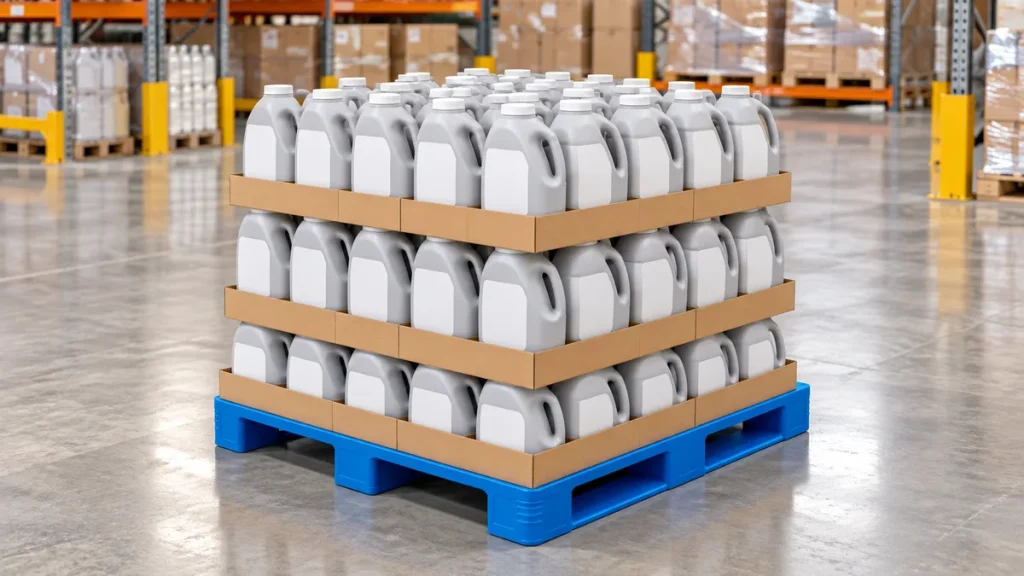
Detergent containers are usually easy to stack until a warehouse team has to move a full unit load through a busy route. Bottles may be placed in trays, cartons or shrink-wrapped layers. They may be handled by forklift, pallet jack or conveyor transfer. A plastic pallet has to support the package arrangement that actually leaves the packing area, not a simplified version of it.
Buyers looking at plastic pallets for chemical and paper operations should begin with the container layout. The footprint of the outer tray, the shape of the bottle base, the layer count and the handling route all affect the right deck and pallet structure.
Map the load from the bottom layer upward
Start with the lowest layer, because it carries the combined weight of the layers above. Record whether containers sit directly on the pallet, in a corrugated tray, or inside an outer carton. A tray with a continuous base spreads its contact differently from a tray with cut-outs or only narrow rails. That changes how much deck support the load needs.
The container pattern matters too. Round bottles, rectangular jugs and handled containers leave different gaps between units. A tight layer can still shift if the tray is weak or the pattern leaves unsupported corners. A simple layer drawing, with the outer dimensions and bottle count, gives a supplier more useful information than a description such as “standard detergent bottles.”
Choose the deck around contact and cleaning
Flat decks can provide broad contact below trays and cartons. Grid decks may be appropriate where the actual load has enough bearing points and the operating conditions suit that structure. Neither description proves that every product package will be supported correctly. The proposed package should be tested on the exact pallet deck before a large order is placed.
Cleaning is another practical consideration. Detergent packaging operations can involve wet floors, drips from handling or dust around cartons and stretch wrap. Buyers should define the cleaning routine and check how the deck, runners and underside will be inspected. The requirement is site-specific. A general statement about plastic being washable does not replace a documented process.
Keep unit loads within the package design
Detergent containers can be stable when full and less stable when partly filled, depending on the bottle shape and closure. Load height, tray stiffness, stretch wrap and corner protection should be reviewed together. The pallet supports the unit load, but it cannot correct a weak carton or a loose upper layer.
When several SKUs use the same tray size, compare the heaviest filled package and the tallest normal stack. That helps the warehouse team avoid selecting a pallet based only on a light trial load. It also keeps the discussion focused on the actual package rather than an assumed universal capacity.
Check handling access before fixing the pallet layout
Forklift entry and pallet-jack access should match the way the load is collected and set down. Some routes need access from more than one side, while others use a repeatable orientation from the packing line to storage. Check the aisle space, fork approach and any transfer equipment before deciding that a particular entry configuration is sufficient.
Storage needs a separate review. Floor staging, block stacking and racking support pallets at different points. Do not use a static or dynamic load figure as a rack rating. If the load will go into racks, confirm the support method, load distribution and the published information for the exact pallet model.
Ask for a model-specific review
A useful request includes the tray or carton dimensions, bottle count per layer, number of layers, filled unit weight, handling equipment, storage method and return flow. Photos of the underside of the tray can be valuable because they show where the load actually bears on the deck.
Product pages remain the source for model-specific dimensions, materials, entry type and published load information. The buyer’s job is to match those details with the detergent container layout and operating route. That produces a more useful comparison than choosing a pallet from an industry label alone.