
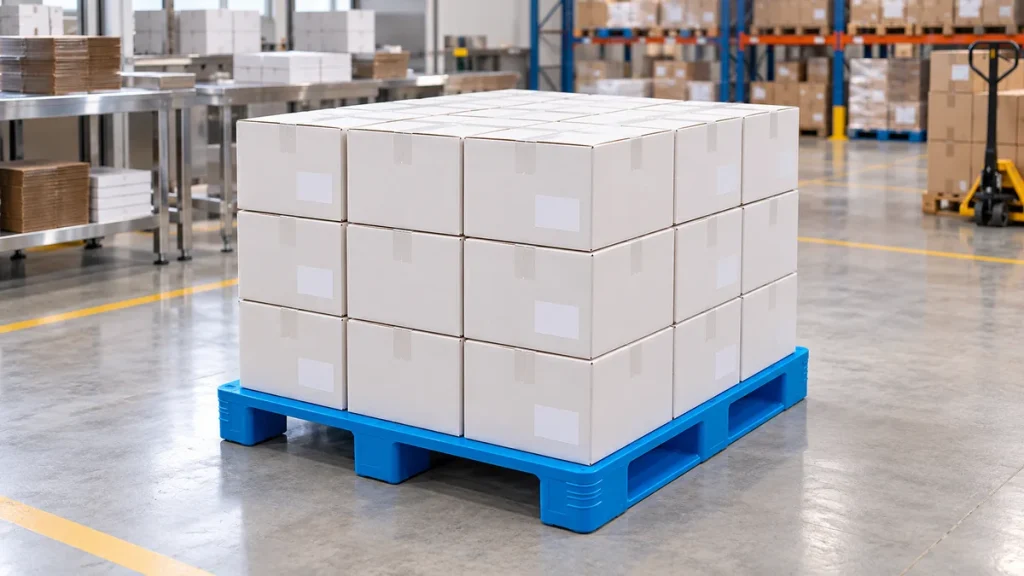
Diagnostic kit cartons can pass through more than one environment before they reach a distributor, laboratory or healthcare channel. They may leave a packing line, wait in a staging area, travel through a warehouse, and move through a handling route that is less controlled than the original packing area. A plastic pallet has to suit that complete route rather than simply look tidy under a stack of cartons.
For buyers comparing plastic pallets for pharmaceutical packing, the useful starting point is the packaged load. Carton footprint, lower-layer contact, handling equipment and storage support usually matter more than a generic claim that one pallet is suitable for every diagnostic-kit operation.
Start with the carton footprint
Check the outer dimensions of the cartons and the proposed layer pattern before choosing a pallet size. The cartons should sit on supported deck areas, with a sensible margin around the load. A pallet that is too small can leave edges unsupported. A pallet that is much larger can waste warehouse space and make the unit load harder to stabilize.
Also look at the bottom face of the carton. Some cartons have a broad, firm base. Others have seams, folded flaps or a smaller contact area. Those details affect whether an open deck, grid deck or flat deck gives the support the load needs. A sample load on the proposed pallet is more useful than judging the deck only from a product photo.
Keep cleaning requirements specific
Plastic surfaces are often chosen because they can be cleaned and do not absorb moisture like damaged timber. That does not remove the need to define the actual cleaning process. Buyers should confirm whether pallets are wiped, washed, dried or kept in a separate clean storage area, then consider how the deck and underside will be inspected between uses.
Diagnostic kits can be packed in different carton formats and shipped through different channels. A buyer should match the pallet to the documented handling and cleaning requirement rather than assume a general industry label proves suitability for every controlled area.
Review the whole handling route
Forklift entry, pallet-jack access, transfer points and empty-pallet returns should all be reviewed with the actual route in mind. A pallet can work well at one point in the process and still cause delays if an entry side is blocked at another point. Ask the warehouse team how loads are picked up, turned, staged and returned before narrowing the choice.
Storage is another separate question. Floor staging, block stacking and rack storage place support in different locations. Do not turn a published static or dynamic figure into a rack rating, and do not assume a structure is suitable for a storage method without checking the supporting beams, load distribution and the pallet model’s published information.
Check packaging stability alongside pallet capacity
A stable diagnostic-kit carton load depends on the cartons as well as the pallet. Layer pattern, carton strength, stretch wrap, edge protection and the number of layers can all change how the load behaves during acceleration or braking. The aim is to keep the load square, supported and within the limits of the packaging design.
When the same carton is used for several products, record the heaviest filled version and the tallest proposed stack. That gives the supplier and warehouse team a clear starting point for a model-specific review. It also avoids treating an empty carton trial as proof that a fully loaded shipment will behave the same way.
Prepare a practical request for quotation
A useful request includes the pallet size range, carton dimensions, loaded weight, layer count, handling equipment, storage method and expected return flow. If cleaning is part of the decision, state the process rather than using a broad description. Photos or a simple layer drawing can show deck-contact needs faster than a general request for a heavy-duty pallet.
Product pages should remain the source for model-specific dimensions, materials, entry type and published load information. The buyer’s job is to connect those facts to the real packing and handling route. That is the safest way to compare pallet options for diagnostic-kit cartons without making assumptions from an industry name alone.