
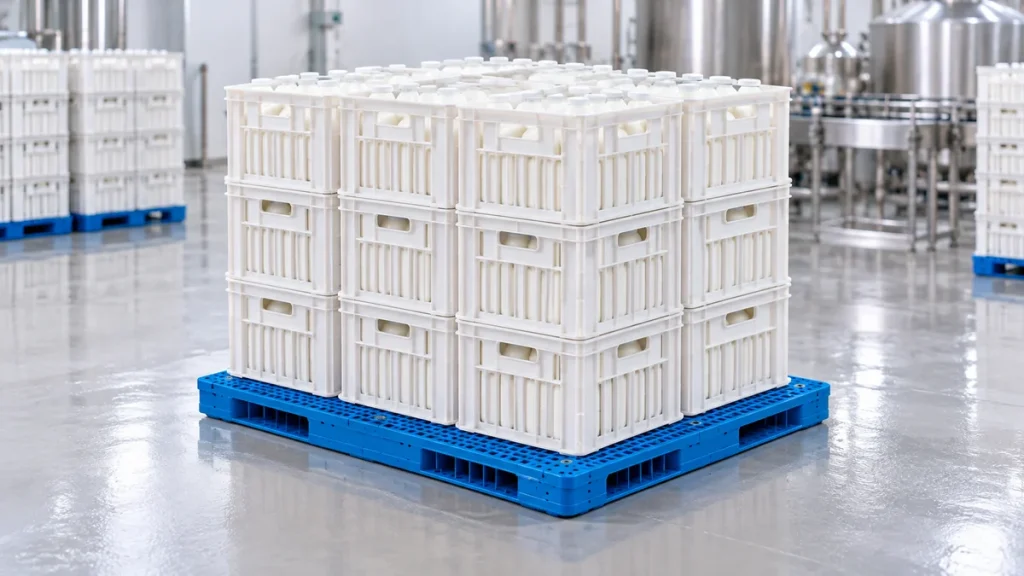
Dairy crates create a load that changes throughout the day. The same pallet may carry full crates from production, return empty crates later, and pass through wet floors or chilled areas between those moves. A suitable pallet has to fit the crate pattern and the handling route, not just the outside dimensions of one crate.
This guide sets out the practical checks for selecting plastic pallets for dairy crate distribution.
Map the real crate pattern
Start with the crate footprint, height, filled weight, number of crates per layer and normal stack height. Include the outer crates in the drawing. A pallet can have enough overall area while still leaving corners or edges poorly supported if the crate arrangement does not match the deck.
Also check whether loaded crates interlock or rely on wrap, straps or another restraint method. The stack needs to remain aligned during the normal route, not only when it is standing still at the end of a packing line.
Match deck contact to the crate base
The crate base determines where its weight reaches the pallet. A flat deck can provide broad support beneath crate bases. An open deck can also work where the crate base and deck pattern have been reviewed together. The correct choice depends on the actual crate design, not on a rule that one deck style suits every dairy load.
Do not use a general load rating as a substitute for reviewing the crate pattern. A static-load figure describes a pallet at rest on a supported floor. A tall crate stack, an uneven layer or an active handling route creates a different operating condition.
Separate loaded and empty-return handling
Full dairy crates and empty returns are different loads. Filled crates place more weight on the deck and may have a taller centre of gravity. Empty crates may be nested or stacked in another pattern, so their return route needs its own review.
Record the equipment used for each stage, including entry direction, fork dimensions and travel surface. If the operation uses more than one handling method, assess each one separately. A pallet that works well in one section of the route should not be assumed to fit all of them.
Review wet, chilled and cleaning conditions
Dairy distribution often involves washdown, condensation or chilled handling. Review the cleaning process, drainage requirement and expected floor condition with the selected pallet structure. Plastic pallets can be cleaned, but the deck and base design still have to fit the operation.
It is also worth checking the time between cleaning and use. Water retained in a crate or on a pallet surface can affect handling conditions, especially when loads are moved onto smoother floors or into a transport vehicle.
Check storage support separately
Floor staging, vehicle loading and elevated storage do not support a pallet in the same way. If the load will be put on a rack or another raised structure, give the supplier the support layout, span, crate pattern and loaded weight. A pallet suitable for a supported floor position is not automatically confirmed for every elevated-storage arrangement.
Run a realistic trial
Before standardising a pallet, test it with the actual crate type and normal stack height. Include the route sections that create the most movement: starts, stops, turns, dock plates and wet-floor transitions. Check crate alignment, deck contact, pallet deflection and equipment clearance.
A short record of the trial helps procurement teams compare alternatives based on the real load. It also avoids treating a generic product description as confirmation for a crate pattern that has not been tested.
Buyer checklist
- What are the crate dimensions, filled weight and normal stack height?
- Where do the outer crates sit relative to the deck edge?
- Does the deck support the actual crate bases?
- How do loaded and empty crates differ in the return route?
- Which handling equipment and floor conditions apply?
- Will the load be floor-stored, elevated or both?
- Can the proposed pallet be tested with a normal full crate stack?
The right plastic pallet for dairy crate distribution supports the real crate pattern and remains stable through cleaning, storage and transport. Start with the actual unit load, then validate the selected structure on the normal route.